

Written by: Belinda Fomba, PMHNP-BC
Last Reviewed: September 2026
Accessing mental health care can be challenging for many people. Long travel times, limited provider availability, work schedules, childcare responsibilities, transportation difficulties, and geographic barriers may make it harder to receive needed care.
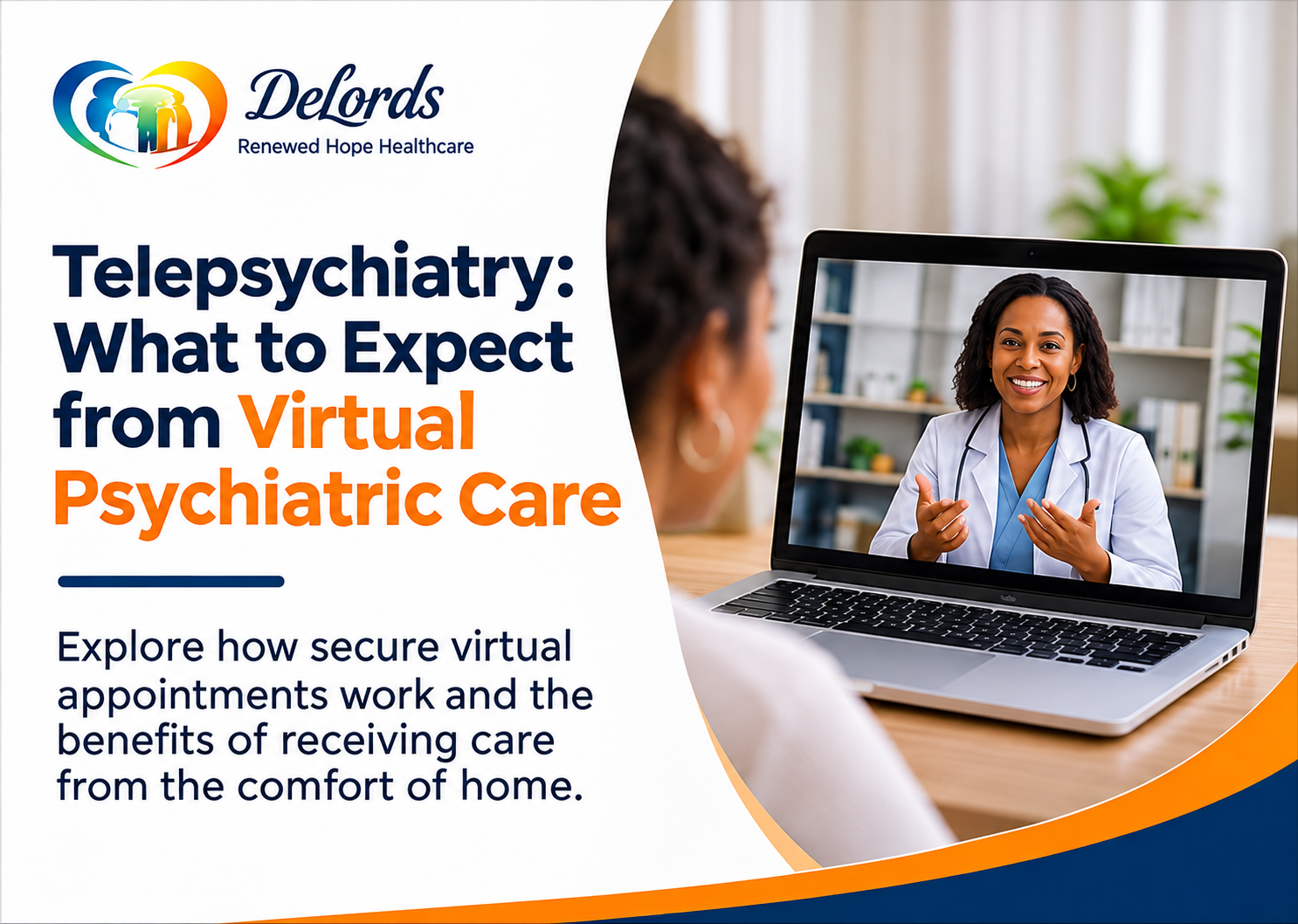
Telepsychiatry has expanded the ways psychiatric services can be delivered. Through secure virtual appointments, patients may be able to connect with qualified psychiatric providers from home or another private location.
For many individuals, this can make mental health care more accessible, convenient, and easier to incorporate into everyday life.
Telepsychiatry is the delivery of psychiatric care using telehealth technology, such as secure video conferencing.
Depending on the patient’s needs and the services offered by the provider, telepsychiatry may be used for:
For many patients and clinical situations, telepsychiatry can provide high-quality psychiatric care without requiring an in-person office visit. However, virtual care may not be appropriate for every patient or every clinical situation, and an in-person evaluation or other level of care may sometimes be recommended.
One of the major benefits of telepsychiatry is its potential to reduce barriers that may make traditional office visits difficult.
Virtual appointments can reduce or eliminate the need to travel to a provider’s office.
This may be particularly helpful for individuals who live in rural or underserved areas, have mobility limitations, lack reliable transportation, or live a significant distance from psychiatric services.
Telepsychiatry may make it easier for some patients to fit appointments into work, school, family, and other responsibilities.
Because travel time is reduced, patients may find it easier to incorporate mental health appointments into their schedules.
Some communities have limited access to psychiatric services.
Telepsychiatry may expand access by allowing eligible patients to receive care from providers who are not located nearby, subject to applicable licensing, clinical, insurance, and other requirements.
Some patients appreciate being able to attend appointments from a familiar environment.
For certain individuals, being at home or in another comfortable private setting may make it easier to discuss sensitive mental health concerns.
Transportation difficulties, distance, weather, mobility challenges, and the time required to travel to appointments can make traditional office visits more difficult.
Virtual care can reduce many of these barriers.
Some individuals may appreciate the discretion of receiving care without traveling to a mental health clinic.
However, privacy is still important during a virtual appointment. Patients should, whenever possible, participate from a private location and use a secure internet connection and personal device.
Research supports telepsychiatry as an effective approach to care for many patients and mental health conditions.
Virtual mental health care may be used as part of the evaluation and treatment of conditions such as:
Research has also found high levels of patient and provider satisfaction with telepsychiatry, and studies have demonstrated outcomes comparable to in-person psychiatric care in a variety of clinical settings.
However, the appropriateness and effectiveness of virtual care depend on the individual’s clinical needs, circumstances, available technology, and other factors. Some situations may require in-person assessment or a different level of care.
A telepsychiatry appointment may be similar in many ways to an in-person psychiatric visit.
Depending on the purpose of the appointment, your provider may:
Your provider may also confirm information such as your identity and current location and discuss what to do if an urgent situation occurs during the appointment.
Patient privacy and confidentiality remain important during virtual care.
Healthcare providers subject to HIPAA must use telehealth practices and technologies that comply with applicable privacy and security requirements.
Patients can also take steps to protect their privacy by:
If you have questions about the technology used for your appointment or how your information is protected, ask your healthcare provider before or during your visit.
Telepsychiatry may be especially convenient for:
However, telepsychiatry is not necessarily the right option for everyone. A healthcare professional can help determine whether virtual care is appropriate based on a person’s symptoms, safety needs, clinical circumstances, and treatment goals.
Telepsychiatry has become an important option for delivering mental health services and can complement traditional in-person care.
Rather than viewing virtual and in-person care as competing approaches, they can be considered different ways of delivering care depending on the patient’s needs and circumstances.
For some individuals, care may be provided primarily through telehealth. For others, a combination of virtual and in-person appointments may be more appropriate.
At DeLords Renewed Hope Healthcare, we are committed to making compassionate, personalized psychiatric care more accessible.
We offer telehealth psychiatric services to eligible patients, including psychiatric evaluations, medication management, and follow-up care. Our goal is to provide convenient access to individualized mental health care while maintaining appropriate clinical, privacy, and professional standards.
Availability of telehealth services depends on factors such as the patient’s location, clinical needs, and applicable requirements.
Ready to take the next step? Contact DeLords Renewed Hope Healthcare or request an appointment to learn whether telepsychiatry may be appropriate for you.
Disclaimer:
This article is for general educational purposes only and is not intended to provide medical advice, diagnose a condition, or replace individualized evaluation or treatment by a qualified healthcare professional. Treatment decisions should be made in consultation with an appropriately qualified healthcare professional.

P.O. Box 503
Queen Creek, AZ 85142
Phone : (480) 685-8960
Fax: (480) 347-9705